REVIEW · BOSTON
Boston Harborwalk & Tea Party Self-Guided Walking Audio Tour
Book on Viator →Operated by Stories with Action · Bookable on Viator
Tea Party stories, timed to your steps.
I like how this tour turns Boston into a walkable storybook, with GPS-triggered audio you control at your pace. You get Tea Party context that goes beyond the famous tea-dumping moment. The main thing to consider is practical: you’ll need to bring your phone (and headphones) and download the tour on solid connection before you rely on offline playback.
I also like the independence. There’s no group meeting and no waiting around. Start when you want within the posted hours, pause for photos or snacks, and keep going until you finish the route.
You’re walking the historic waterfront stretch from South Station toward Long Wharf, with bonus stops that line up with big landmarks like the Aquarium. Plan for a little back-and-forth in your timing because the experience is designed around audio segments you trigger by location, not a strict clock.
In This Review
- Key things to know before you go
- Why This Harborwalk Audio Tour Works (Even If You Hate “Tour Time”)
- South Station: Eagle, Clock, and the Start of the Story
- Tea Party Stories Along the Harborwalk: Why the Riot Really Happened
- Federal Reserve Bank of Boston and Atlantic Wharf: Plain Names, Big Meaning
- Harbor Towers Brutalism and the Fight Between Affordable and Luxury Living
- Rowes Wharf, the Harbor Hotel Dome, and the Long Wharf Finish
- Aquarium Stop and the Harborwalk Section You Actually Cover
- Price and Time: Is $9.99 Actually Good Value?
- Getting the App Right: Offline Listening and Device Reality
- Who Should Book This (and Who Might Want a Different Format)
- Should You Book the Boston Harborwalk & Tea Party Audio Tour?
- FAQ
- How much does the Boston Harborwalk & Tea Party self-guided audio tour cost?
- How long does the tour take?
- Where does the tour start?
- Does anyone meet you at the start?
- How does the audio work during the walk?
- Does the tour work offline?
- Are attraction tickets included for places like the Aquarium?
- What devices are recommended for using the tour?
- Can I use the tour more than once?
- Can I get a full refund if I cancel?
Key things to know before you go

- Self-guided, no guide in front of you: you start at the first audio point and let GPS cues run the rest.
- Hands-free listening: stories play automatically based on where you are.
- Works offline after downloading: no signal needed once the audio is saved on your device.
- Lifetime access, no expiry: your purchase stays usable on future trips.
- Focused waterfront route: about 1 mile of the waterfront core from South Station to Long Wharf, with extra nearby stops.
- Low cost for a long window of use: $9.99 is a bargain compared with typical guided tours, especially since you can repeat it.
Why This Harborwalk Audio Tour Works (Even If You Hate “Tour Time”)
This isn’t a sit-and-get history lecture. It’s a walking tour that treats time like yours. You can slow down for harbor photos, speed up when you’re cruising, and skip what you’re not feeling. That matters in Boston, where the streets are busy and your best energy often comes from choosing your own pace.
The audio is location-based, so you’re not stuck holding your phone like a treasure hunter. Once you enter the app and start at the correct beginning point, the narration lines up with what you’re looking at. And because it’s hands-free, you can actually enjoy the waterfront instead of tracking your screen.
Two practical advantages make this a strong value. First, the offline setup means you can still explore if your cell signal acts weird along the water. Second, it’s lifetime access, so you can reuse it later—at home, on another trip, or when you want a refresher.
The one drawback: if your phone battery is low or your GPS is temperamental, you’ll feel it. Bringing earbuds and a charged device is not optional. It’s the difference between smooth stories and annoying audio gaps.
You can also read our reviews of more tours and experiences in Boston.

South Station: Eagle, Clock, and the Start of the Story

You kick things off at South Station, one of Boston’s major transport landmarks that often gets rushed past. The first stop spotlights the massive eagle and clock dominating the facade—an attention-grabbing way to begin because it immediately gives you a sense of “this city has a past, and it shows.”
South Station also sets up the tour’s tone. It’s not only about Revolutionary-era drama. It’s about how Boston uses architecture and everyday landmarks to keep telling its story, even when you’re just trying to get somewhere else.
Timing-wise, you’ll see guidance that the early audio begins right at the first story point and then moves along a route that’s roughly 1.5 miles total with more than 18 audio stories. That means this tour works best if you expect a relaxed walking rhythm, not a sprint.
Tip: since this is self-guided, you’re the pilot. When you arrive, open the app and start the tour at the correct first audio location so GPS can do its job from the start.
Tea Party Stories Along the Harborwalk: Why the Riot Really Happened
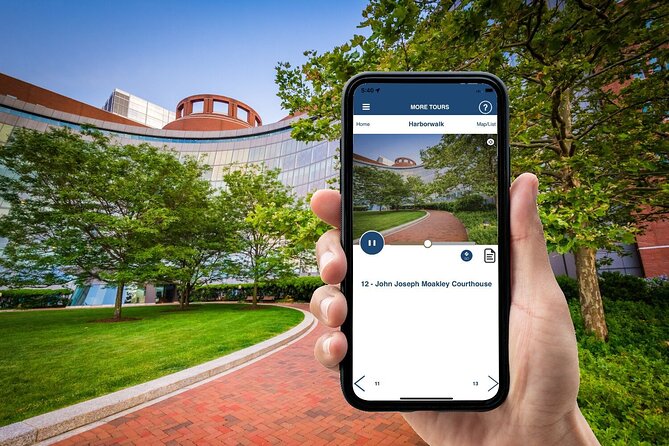
The next stretch brings you onto the Harborwalk and points your eyes across the water. You’ll get that classic Tea Party connection through a glimpse of a colonial ship idea—something packed with tea crates—and the narration links it to the events of the Boston Tea Party.
But the part I think you’ll enjoy most is the explanation behind the fireworks. You’re not only hearing what happened. You’re hearing questions that make it stick: what caused the riot, why taxes were so high, and how a far-away international war ends up shaping the price of tea in Boston.
That’s where this tour earns its keep. It nudges you past the “famous event” version of history and toward the cause-and-effect story. You’ll leave with clearer context for why ordinary people were willing to make a big public mess.
Practical note: bring binocular-free patience. You’re not stepping into a museum here. You’re using the water views and skyline cues to anchor the narration, and that works best when you slow down just enough to look around.
Federal Reserve Bank of Boston and Atlantic Wharf: Plain Names, Big Meaning

After you’ve taken in the harbor angle, you cross street energy with a sharp contrast: the Federal Reserve Bank of Boston stop. The narration’s focus is the story hidden in the bland name and the architecture itself. Modern design can feel like it’s trying hard to be neutral, but the tour gives you a reason to notice it anyway.
Right after that, you reach Atlantic Wharf at Russia Wharf. This is where the tour flips from politics to commerce. You’ll learn about colonial-era international trade—and how that booming activity laid the groundwork for the later Tea Party moment.
This pairing works well because it shows two sides of the same coin. You get the institution side (the Federal Reserve stop) and the trade pipeline side (Atlantic Wharf). One explains structure. The other explains motivation.
Also, you’re constantly walking along a coherent route. That means you don’t feel like you’re jumping between unrelated stops. You’re seeing the waterfront’s logic unfold as you go.
Harbor Towers Brutalism and the Fight Between Affordable and Luxury Living

Next comes a stop you can’t ignore: Harbor Towers. These Brutalist-style buildings are described as polarizing for a reason. Their sparse, fortress-like look is hard to miss, and the tour leans into that reaction instead of trying to soften it.
Here, the audio connects architecture to social issues. You’ll hear about Boston’s struggle between affordable and luxury living and how this very harbor became part of one of the city’s ambitious cleanup efforts. That’s the point: you’re not just watching buildings. You’re learning how design and policy collide.
Possible consideration: if Brutalism makes you instantly cranky, this stop might feel like a debate you didn’t ask for. But the narration turns the “I either like it or I hate it” instinct into something you can talk about afterward—especially if you’re the type who notices how cities decide who gets space.
Photo tip: the towers are easier to frame when you give yourself a few seconds to find an angle where the shapes look intentional, not accidental.
Rowes Wharf, the Harbor Hotel Dome, and the Long Wharf Finish

From Harbor Towers, the tour keeps tightening the historic thread with names and small clues. At Rowes Wharf, you learn the area was named for John Rowe, described here as one of the tea smugglers who helped stir the Tea Party. The narration also brings in his adventures with the law. That’s a fun change of pace—history with a human (and not fully legal) edge.
Then you move to the Marina at Rowes Wharf, with the Harbor Hotel described as a standout blend of modern and colonial styles. The big visual is the 80-foot copper dome and the glass cupola. There’s even a specific way to see through it: stand near the center of the archway and look straight up so you can line up the through-view to the glass cupola above.
This is one of those stops that feels like the tour is handing you a mini “spotter’s task.” It gives you something to do besides walk: align your viewpoint, then look for the architectural payoff.
Finally, you reach Long Wharf, where the Harborwalk story ends. Long Wharf is framed as a historic hotspot that connects colonial battles against the British to the modern crowd scene. You’ll likely pause here longer than you planned, because the waterfront views and activity level make it hard to rush.
Aquarium Stop and the Harborwalk Section You Actually Cover

Near the end, you approach the New England Aquarium, which is described as partially built over the Harbor. The audio notes that the structure is designed to give the aquarium access to Boston Harbor’s natural environment. Even if you don’t buy an entry ticket, the setting helps you understand why the location matters.
One important detail for managing expectations: the broader Harborwalk is listed as 43 miles long, but this tour focuses on the historic Waterfront District from South Station to Long Wharf—about 1 mile. That’s why the experience stays in the 2 to 3 hour range overall. You get a concentrated slice instead of a marathon of waterfront time.
If you’re trying to decide what else to do that day, this tour naturally funnels you into the Seaport/Waterfront area where food and wandering are easy. The timing is good for slotting in lunch or a follow-on stop after you finish the audio sequence.
Price and Time: Is $9.99 Actually Good Value?
At $9.99 per person, this is priced like a “small splurge” and it plays like a full afternoon activity. The value isn’t just the content. It’s what you get for the price: a self-guided audio app, offline maps, hands-free playback, and lifetime access with no expiry.
Most walking tours force you into a fixed schedule. This one doesn’t. You start anytime within the operating window, pause anywhere, and repeat later. That makes it cost-effective even if you only use it once during this trip—because the experience stays in your back pocket for future visits.
And the ticket situation is straightforward. The stops are described with free admission ticket notes, but attraction entry tickets or passes are not included. Translation: you can do the walk and the stories without paying for entry to each major site. If you want the aquarium or other attractions, you’ll need to budget separately.
Time-wise, expect 2 to 3 hours if you’re stopping for photos and listening comfortably. The audio itself is described as taking about 1 to 2 hours for the longer route segment, so you’re not locked into constant narration the entire time. You’re also free to skip parts and keep moving if you’re pressed.
Getting the App Right: Offline Listening and Device Reality
This is one of those tours where preparation changes everything. After you book, you’ll get an email and text with setup instructions and a password. You also need to use the Action app for the tour download, and you’ll enter the password to start.
The key tip is the download requirement. You must download the tour while you have strong Wi‑Fi/cellular, and then it works offline after that. If you try to save it all at the start with a weak connection, you can end up with avoidable frustration near the water.
Device recommendations are spelled out: an iPhone running iOS 15 or later, an Android device version 9 or later, or an iPad/tablet with GPS and cellular connectivity. GPS matters because the audio plays based on location.
Headphones are strongly recommended for the best experience. That’s not just for sound quality. It also makes the “hands-free” promise real. If you’re using speakerphone on a windy waterfront, you’ll miss details and hate the setup.
And if you’re hearing audio issues, there’s support mentioned. If it doesn’t fix itself quickly, don’t keep trying to power through like it’s a Broadway show. Get help so you can enjoy the walking part again.
Who Should Book This (and Who Might Want a Different Format)
This tour is a great fit if you like history that you can measure in steps. You’ll enjoy it most if you want Boston’s story told while you’re looking at the buildings, the wharf, and the harbor.
It’s also ideal for people who want independence. No need to coordinate with a group, no pressure to keep up. Start whenever you like and stop for breaks without feeling like you’re holding anyone back.
You might want a different option if you prefer a live guide, because this is explicitly self-guided. Also, if you don’t want to rely on a phone for navigation or audio, the GPS-based format will feel like extra work. This is still “easy,” but it’s not paper-map nostalgia.
Finally, it’s designed for most travelers to participate, but you should still expect a walk along the waterfront and between stops. Plan footwear like you mean it.
Should You Book the Boston Harborwalk & Tea Party Audio Tour?
Yes, if you want an affordable, flexible way to connect Boston’s waterfront to the Tea Party story, with hands-free audio that keeps you oriented. The $9.99 price is hard to beat because you get lifetime access and offline use, not just one-time entertainment.
Skip it only if you know you hate phone-based tours or you’re unwilling to download the app on good Wi‑Fi/cellular first. If you’re fine with earbuds and a charged device, this is a smart buy for a self-paced afternoon.
FAQ
How much does the Boston Harborwalk & Tea Party self-guided audio tour cost?
It costs $9.99 per person.
How long does the tour take?
It’s listed as about 2 to 3 hours in total, and the audio route is described as about 1 to 2 hours to complete.
Where does the tour start?
The tour begins at South Station.
Does anyone meet you at the start?
No. This is self-guided. You go to the starting point and enter the first story’s point so the audio starts automatically.
How does the audio work during the walk?
After you download and start the tour, the app plays audio stories automatically based on your location. You can pause and start again as you want.
Does the tour work offline?
Yes. Offline maps are included, and after you download the tour on strong Wi‑Fi/cellular, it works offline without cellular or Wi‑Fi.
Are attraction tickets included for places like the Aquarium?
No. Attraction passes, entry tickets, or reservations are not included.
What devices are recommended for using the tour?
An iPhone with iOS 15 or later, an Android device version 9 or later, or an iPad/tablet with GPS and cellular connectivity are recommended.
Can I use the tour more than once?
Yes. It’s sold as new, lifetime access with no expiry, so you can use it anytime on any trip as many times as you want.
Can I get a full refund if I cancel?
Free cancellation is available up to 24 hours in advance for a full refund. If you cancel less than 24 hours before the experience start time, there is no refund.