
REVIEW · GLASGOW
Glasgow Afternoon Tea Experience
Book on Viator →Operated by Red Bus Bistro Company Limited · Bookable on Viator
Tea on a vintage bus makes Glasgow click. This Glasgow Afternoon Tea experience lets you eat and sip while cruising past headline sights, from George Square to Glasgow Cathedral, all in a classic Routemaster-style setting. It runs about 70–90 minutes, with mobile ticket ease and a menu built around traditional tea-table favorites.
What I like most is the food-first setup. You get handmade sandwich selections, a home-baked warm scone with cream and jam, plus petit fours, cupcakes, and unlimited tea and coffee to keep the rhythm easy. I also like the human touch on board, with hosts such as Helen, plus other crew members like Tallulah and George, who help make the ride feel fun instead of stiff.
The main downside to plan for is comfort. The bus is vintage, there’s no AC, and there’s no toilet on board, so hot weather and quick pit-stop needs are on you to manage.
In This Review
- Key highlights worth clocking before you go
- How the Afternoon Tea on a Vintage Routemaster actually feels
- Vintage bus comfort: no AC, no toilet, and tight seating
- Expect light patter, not full guided narration
- From Glasgow’s art-museum stop to George Square and the City Chambers
- Glasgow Cathedral and the Necropolis: medieval survival and Victorian storytelling
- Tolbooth Steeple and the Doulton Fountain: civic power meets exhibition spectacle
- People’s Palace and Wellpark Brewery: how Glasgow tells everyday stories
- The Clyde bridges and Finnieston Crane: engineering you can spot fast
- SEC Armadillo, SSE Hydro, and the whisky distillery area
- Riverside Museum, the Science Centre tower, and Kelvingrove Museum from the road
- West End and civic highlights: Tennent’s Bar, the Hunterian, University of Glasgow, and the Mitchell Library
- Is the $61.46 price worth it for tea plus a city sightline?
- Who should book this bus-tea experience (and who should skip it)
- Should you book the Glasgow Afternoon Tea on a Vintage Bus?
- FAQ
- How long is the Glasgow Afternoon Tea Experience?
- What’s included with the afternoon tea?
- Is there a toilet on the bus?
- Do you provide guide commentary while driving?
- Can I request gluten-free or vegetarian options?
- Where does the tour start, and how early should I arrive?
- Will I share a table with other guests?
Key highlights worth clocking before you go
- Unlimited tea and coffee with a full afternoon-tea spread (sandwiches, scone, sweets)
- A vintage Routemaster bus that turns sightseeing into a seated, snack-based city circuit
- City landmarks without the walking fatigue, great for a first afternoon or a rain day
- Hosts keep things light, including singalongs at times, but it’s not a museum-lecture style tour
- Tight seating and table sharing can be part of the deal on busier departures
- You’ll pass major sights along the way, from Glasgow Cathedral and the Necropolis to Clyde bridges and modern venues
How the Afternoon Tea on a Vintage Routemaster actually feels
Think of this as dining with a moving city backdrop. You sit at your table, get served as the bus rolls, and you focus on eating while the route strings together major Glasgow sights.
The experience is priced at $61.46 per person, and it’s designed as a one-and-done stop that fits neatly into a busy day. You’re generally looking at about 1 hour 30 minutes, though the operator notes it can run 70–90 minutes depending on conditions.
The menu is very classic: handmade sandwiches, a warm scone served with cream and jam (with a strawberry garnish mentioned), plus petit fours and cupcakes. On top of that, unlimited tea & coffee means you’re not rationing refills or paying for each drink as you go.
One practical note: this is a shared-table style experience at times. The operator asks guests to expect sharing, especially on busy weekends, though they’ll try to accommodate if you prefer not to share and you pick a quieter tour.
You can also read our reviews of more tours and experiences in Glasgow.

Vintage bus comfort: no AC, no toilet, and tight seating
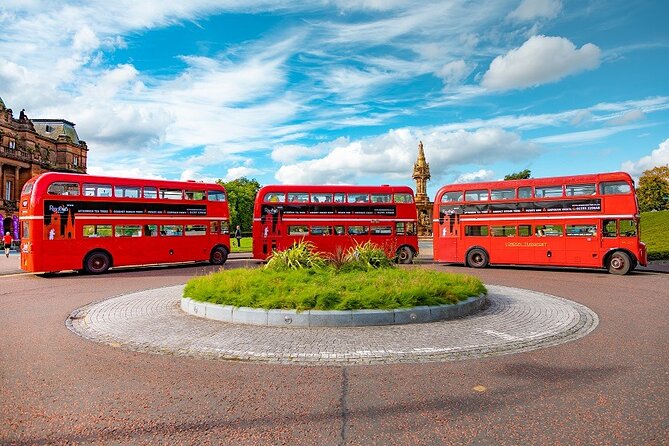
This ride runs on a vintage Routemaster, and it’s part of the charm—but you should plan around it. The bus has fans, but there is no air conditioning, so warm weather can make you feel the heat more than you would on a modern coach.
Also, there’s no toilet on board. If you’re traveling with kids or you’re sensitive to long waits, build in a restroom stop before you arrive at 36 Shuttle St, Glasgow G1 1QA.
Seating is another factor. Even though it’s a small-guest setup (maximum 20 travelers), the bus layout can feel tight, and some seats will compress your space more than others. If you’re booking because you want maximum comfort, choose your expectations accordingly.
Expect light patter, not full guided narration
The operator is very clear that this is a dining experience while touring, not a traditional step-by-step guided tour. Their terms say they do not offer live or recorded guide commentary on the buses, though there may be some guiding-style remarks and the day can include a singalong.
In practice, that means the crew may point out important places and keep the mood lively, but you shouldn’t expect a blow-by-blow history lesson for every turn. If you want deep facts and museum-level detail, pair this with a walking tour or a museum visit on another part of your day.
The best part is that the hosts still tend to make it feel personal. Reviews mention entertainers and hosts like Helen doing double duty, plus other crew members, which helps explain why many people come away feeling like it was a fun activity, not just a meal on wheels.
From Glasgow’s art-museum stop to George Square and the City Chambers
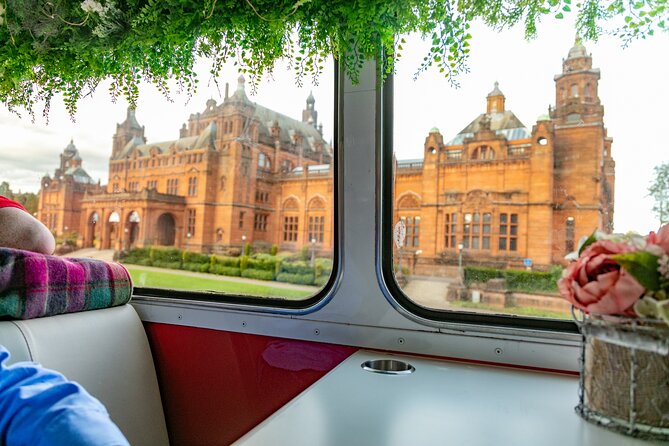
Your route begins in central Glasgow with a world-class art museum stop described as a place where people gather, learn, and share ideas. From the bus, that typically means you’ll clock the building and surroundings rather than go inside, so think of this as an exterior-and-area orientation moment.
Next up is George Square, Glasgow’s grand civic hub. The highlight here is the City Chambers, described as imposing and tied to the city’s wealth and industrial prosperity. This is the kind of landmark that quickly tells you Glasgow is both historic and proudly self-confident.
If you’re arriving on a short visit and want to build a mental map fast, this section is useful. It helps connect later sights—churches, cemeteries, museums—into one coherent story of how Glasgow grew.
Glasgow Cathedral and the Necropolis: medieval survival and Victorian storytelling
Glasgow Cathedral is one of the strongest stops on the circuit. The description calls it one of Scotland’s most magnificent medieval buildings, and it’s especially notable because it survived the Reformation of 1560 intact.
Right after that, you’ll move into the Necropolis, a Victorian garden cemetery known for architecture, sculpture, and the stories behind the graves. The operator notes it’s modeled on Père-Lachaise in Paris, with an estimated 50,000 burials and around 3,500 tombs—that scale is part of what makes it feel like a city within a city.
What makes this stop valuable from the bus is contrast. One is medieval stone still standing through major upheaval; the other is a carefully planned Victorian “afterlife neighborhood.” Even without entering, you’ll get a clearer sense of how Glasgow turns major eras into visible streetscapes.

Tolbooth Steeple and the Doulton Fountain: civic power meets exhibition spectacle
In the city center, you’ll pass the Tolbooth Steeple, described as Glasgow Cross’s most important feature, topped with a clock and a stone crown. The Tolbooth building it once belonged to covered practical city functions: town clerk offices, council hall, and a city prison.
This is a good stop for people who like landmarks that explain how daily governance worked, not just how a building looks. From the road, you can still pick out the steeple’s role as a focal point.
Then you get the Doulton fountain, linked to the 1888 International Exhibition in Kelvingrove Park, an event that attracted over 5.7 million visitors. The fountain is noted as the largest fountain ever constructed in ceramic, which makes it easy to imagine why it caught crowds’ attention.
If your itinerary is tight, this is the kind of stop that helps you understand why Glasgow has such an instinct for public monuments—something you’ll feel again near the modern venues by the river.
People’s Palace and Wellpark Brewery: how Glasgow tells everyday stories
On Glasgow Green, you’ll see the People’s Palace, which the description says carries a collection of objects, photographs, prints, and film showing how Glaswegians lived, worked, and played. From the bus, you’ll likely get the setting and the idea more than a full gallery experience, but it’s a helpful nudge toward local culture.
Then the route includes Tennent’s Wellpark Brewery, described as part of Scotland and its culture for generations and producing award-winning brews since 1885. This is a reminder that Glasgow isn’t only museums and churches—it’s also industrial rhythm and social life.
If you’re the type who likes your sightseeing to connect to how people actually live, these stops steer you away from pure postcard landmarks.
The Clyde bridges and Finnieston Crane: engineering you can spot fast
Glasgow’s river story comes through in three big engineering icons.
First is Kingston Bridge, a busy cantilever road bridge carrying the M8 through the city center. It’s described as carrying around 150,000 vehicles every day, which helps you understand why the river crossings matter so much to the city’s movement.
Next you’ll pass the Clyde Arc, known for its curved design and for spanning between Finnieston and Pacific Quay/Glasgow Science Centre area. The description highlights how it crosses at an angle, making it visually noticeable even at bus speed.
Finally, the Finnieston Crane (Stobcross Crane) appears as a disused giant cantilever crane kept as a symbol of Glasgow’s engineering heritage. It’s still operational in some respect, and it was used for loading cargo, including steam locomotives, onto ships for export.
These stops are great if you’re traveling with someone who gets bored by churches. Engineering landmarks often beat the “same skyline” feeling because they’re immediately legible.
SEC Armadillo, SSE Hydro, and the whisky distillery area
As you move toward the waterfront, you’ll see major modern venues and entertainment spaces.
The SEC Armadillo is described as a purpose-built venue and Glasgow landmark designed by Foster + Partners, opening in 1997 as part of the renewed energy of the waterfront. It’s the kind of structure that instantly tells you Glasgow can do bold, forward-looking design.
You’ll also pass the SSE Hydro, a multi-purpose indoor arena on the Scottish Event Campus. It originally got its name from sponsor Scottish & Southern Energy’s Scottish Hydro subsidiary.
Then comes the single malt Scotch whisky distillery noted as Glasgow’s first dedicated one in over 100 years, with a visitor experience, cafe, and whisky shop mentioned. From the bus, you’ll mainly see the location vibe, but it’s still a strong thematic link: Glasgow’s industrial identity, now turned into craft and visitor culture.
Riverside Museum, the Science Centre tower, and Kelvingrove Museum from the road
Glasgow’s museum strength is hard to ignore, and your route touches several big names.
The Riverside Museum is described as award-winning, with over 3,000 objects covering transport history—everything from skateboards to locomotives, prams to cars, even a Stormtrooper. Again, this is a bus pass style stop, so use it for orientation: you’ll know where to go later if you want to spend hours inside.
Nearby, the Glasgow Tower, part of the Glasgow Science Centre complex, appears as a free-standing tower on the south bank of the Clyde. The idea here is science-meets-city, visible even if you never climb.
Your circuit also includes the Kelvingrove Museum area, described as opened in 1901 and a family-friendly favorite. You’ll get the exterior context and an easy mental link to why this neighborhood is so visitor-friendly.
West End and civic highlights: Tennent’s Bar, the Hunterian, University of Glasgow, and the Mitchell Library
Toward the end, the route shifts from big public landmarks to institutions that shape Glasgow’s identity.
Tennent’s Bar is mentioned as a beloved city center local in the West End, known for great beers, tasty food, and lively banter, and described as one of the last traditional pubs in the area. Even without stepping inside, seeing where locals gather gives the trip a real-world pulse.
You’ll also pass the Hunterian Art Gallery, described as holding one of Scotland’s most distinguished public art collections. Works mentioned include Rubens and Rembrandt, plus the Scottish Colourists and Glasgow Boys.
Then it’s the University of Glasgow, noted as changing the world since 1451, with figures like Adam Smith, James Watt, and Lord Kelvin called out. This is a stop that matters if you want Glasgow to feel like ideas, not only industry.
Finally, you’ll reach the Mitchell Library at Charing Cross, described as central to Glasgow Libraries and containing some of the finest collections available to any public library. It’s accessible to everyone and is framed as a place for research, inspiration, and enjoyment.
If you like your sightseeing to include institutions people rely on—education, libraries, public art—this portion of the route keeps it grounded.
Is the $61.46 price worth it for tea plus a city sightline?
Here’s how I’d judge the value.
You’re paying for two things: a full afternoon-tea spread (sandwiches, warm scone with cream and jam, petit fours, cupcakes, unlimited tea and coffee) and a one-and-a-half-hour route that helps you tick off major sights without stacking long walks.
For many first-time visitors, that combination is the point. You don’t have to choose between eating well and seeing the city—you do both in one session, and you’re seated most of the time.
The operator also caps the group at 20 travelers, which usually helps preserve a calmer vibe versus mass coach tours. Add in a strong overall rating of 4.4 and the fact that bookings often happen about 55 days in advance, and you’ve got a decent signal that people like this as a reliable, easy activity.
Who should book this bus-tea experience (and who should skip it)
This works best for:
- First-time visitors who want a quick orientation and a break for tired legs
- People who prefer seated sightseeing over constant walking
- Travelers who enjoy a light, upbeat atmosphere, especially with crew members like Helen keeping things fun
- Families with kids 3 and up (children 3–9 are charged £20, children 10+ are charged at the adult rate, and anyone under 14 must be with an adult)
You might want to pick something else if:
- You strongly want full, turn-by-turn historical commentary (this is explicitly a dining experience, not a guided narration)
- You need air-conditioned comfort
- You feel uncomfortable with tight seating or shared tables
Should you book the Glasgow Afternoon Tea on a Vintage Bus?
If your goal is a pleasant, low-effort way to see Glasgow’s key landmarks while you eat a proper tea spread, I think this is a smart booking. It’s especially good when the weather is unpredictable or when you’re building an itinerary for a short trip.
But go in with the right expectations: this is about food, atmosphere, and landmark recognition, not a museum-style guided lecture. If you want deep history and detailed narration every stop, use this as the fun appetizer and pair it with a walking tour or an indoor museum day.
FAQ
How long is the Glasgow Afternoon Tea Experience?
It runs about 1 hour 30 minutes, and the operator notes it lasts between 70 and 90 minutes depending on conditions.
What’s included with the afternoon tea?
You get handmade sandwich selections, a home-baked warm scone with cream, jam, and strawberry garnish, petit fours, sumptuous cupcakes, and unlimited tea & coffee.
Is there a toilet on the bus?
No. There is no toilet on board.
Do you provide guide commentary while driving?
The operator states they do not offer live or recorded guide commentary on the buses. The experience is mainly a dining format while touring.
Can I request gluten-free or vegetarian options?
Yes. Gluten free or vegetarian options are available if you specify your needs when you book. The products may contain nuts.
Where does the tour start, and how early should I arrive?
The meeting point is 36 Shuttle St, Glasgow G1 1QA. The operator asks you to arrive 10–15 minutes before departure.
Will I share a table with other guests?
You should expect to share a table, especially on busier weekend tours. If you would rather not share, the operator says they can try to accommodate you on a quieter tour.
You Might Also Enjoy
 Xiao Long Bao, Pork thick soup, Bubble milk tea. Taiwan Traditional Light Meals Experience-B (Taipei Cooking Class)
 Mauritius: South Coast Tour with Tea Factory & Gris Gris
 Tuk Tuk safari and Picnic in The Tea Plantation from Ella,Haputale & Bandarawela
 Marrakech: Medina by Night Walking Tour with Moroccan Tea